Laminitis in horses: what is it, how does it develop, and what can you do about it?
Read more


For a sport horse, it is all about balance: enough energy to train and perform, but also enough control to remain focused and rideable. At Cavalor, we therefore look beyond the energy value of a feed. We focus above all on how energy is released, how well it is digested and how the horse’s body uses it.
A horse needs energy to function, recover and perform. Yet requirements vary greatly from one horse to another. Training intensity plays a role, but so do temperament, sensitivity and type of work. A horse competing on three consecutive days needs different nutritional support from a horse that mainly needs controlled work at home. A sensitive horse that quickly builds tension requires a different energy balance from a horse that needs extra power and stamina.
We therefore always distinguish between:
A fresh horse is not automatically fit. And a calm horse does not necessarily have too little energy. It is about providing the right
energy for the right horse.
Sugar and starch provide rapidly available energy. This can be valuable for short, powerful efforts such as jumping, intensive intervals or explosive work. But when energy is released too quickly, it may lead to peaks in tension or reduced control in some horses. Fats and fibers provide slow-release energy. They mainly support sustained efforts and help keep energy release gradual, although fat also has its limits: too much can cause health problems. Choosing the right feed is therefore not about “more” or “less” energy. It is about energy that suits the work, the temperament and the feel you are looking for.
Digestibility makes the difference. An energy source may be perfect in theory, but if your horse cannot digest it properly, the body
cannot use it to its full potential. That is why the way ingredients are processed is so important. Puffed and extruded grains, for example, are effectively pre-digested: the grain structure is opened up, making the starch more readily available for digestion and absorption.
This allows your horse to use energy more efficiently and reduces the amount of undigested starch reaching the hindgut. In this way, you support not only energy supply but also gut balance. Gut balance plays a greater role than many riders realise. The gut absorbs nutrients and helps lay the foundation for health, recovery and day-to-day performance.
Ultimately, it is not only about what you feed. It is about what your horse can do with it. and the feel you are looking for.
Puffed cereals are not only highly digestible, but also very palatable. Their aroma, structure and taste mean they are often readily eaten, even by fussy eaters.
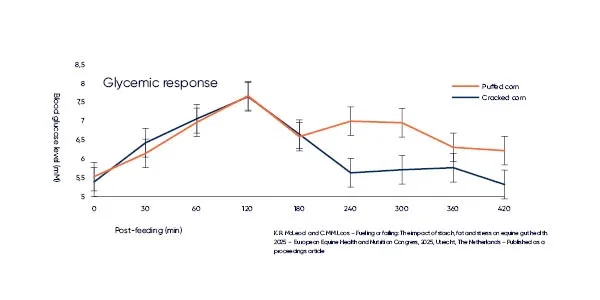
When a horse eats, sugars and starch are converted into glucose, the main energy source for training and performance. However, not all starch is digested equally well. Both the source of the starch and the way grains are processed strongly influence how this energy is released and used in the body. In practice, a rapid rise and fall in blood glucose may be associated in some horses with
greater tension, reduced focus and less consistent energy delivery during work.
Puffed and extruded grains have an almost completely opened starch structure. As a result, starch is digested more effectively in the small intestine and absorbed more efficiently. This leads to a more gradual uptake of glucose and prevents large amounts of undigested starch from reaching the hindgut, where it can disrupt fermentation.
Recent scientific research has also shown that highly digestible starch not only contributes to a more stable blood glucose response, but also places less strain on the gut environment and supports intestinal barrier integrity more effectively than less digestible starch. Therefore, do not look only at the starch percentage on the label, but also at the source and processing method of the grains. Two feeds may have a similar starch content, yet differ greatly in how efficiently a horse can use that starch. Smart starch not only provides controlled energy, but also supports a healthy gut.