My horse has ulcers. Should I use Gastro Aid or omeprazole?
Read more
Laminitis is a serious and painful hoof condition. It is an inflammation of the laminae — the soft connective tissue that binds the hoof wall to the bone inside. When this tissue is damaged, the hoof loses its structural integrity. The result? Intense pain, lameness, and in severe cases, rotation or sinking of the pedal bone.
Laminitis is rightly feared by horse owners worldwide. But what many people don’t realise is that in 90% of cases, it is not a sudden accident — it is the result of an underlying metabolic disorder that has often been developing silently for a long time.
Laminitis is not a rare condition. Far from it.
A large-scale British study (CARE Study, Royal Veterinary College) that followed more than 1,000 horses and ponies found:
The most common signs observed in affected horses:
| Sign | Prevalence in affected horses |
| Difficulty turning | 78% |
| Short, stilted gait | 72% |
| Lameness at walk | 70% |
| Increased hoof temperature | 58% |
| Weight shifting / reluctance to move | 51% |
As mentioned, 90% of all laminitis cases have a hormonal cause. This type is called endocrinopathic laminitis and is directly linked to a disruption of the insulin system — known as insulin dysregulation (ID).
Insulin is an essential hormone that normally regulates:
In horses with ID, this system no longer functions properly. The result is chronically elevated blood insulin levels — a condition called hyperinsulinaemia. Research consistently shows that these persistently high insulin levels damage the laminar tissue inside the hoof. The exact mechanisms involve disruptions in cellular signalling, vascular function, and metabolic processes — a cascade that ultimately leads to a laminitic episode.
ID most commonly develops in horses that are natural ‘easy keepers’: animals that maintain or gain weight easily, even on restricted feed. Think of:
But genetic predisposition, limited exercise, obesity, and concurrent conditions such as PPID (Equine Cushing’s Disease) can all contribute to or worsen ID.
| Risk Factor | Explanation |
| Genetic predisposition | Easy keepers, certain pony and draft breeds |
| High-NSC diet | Feeds rich in sugars and starch trigger insulin spikes |
| Pasture grass (spring/autumn) | High fructan levels after cold-warm weather swings |
| Obesity / fat deposits | Cresty neck, tailhead, behind shoulders are warning signs |
| Limited exercise | Reduces insulin sensitivity |
| PPID (Cushing’s) | Worsens existing insulin dysregulation |
Grasses store sugars in the form of fructans. On warm, sunny days, fructan levels in grass rise. Normally, the plant uses those sugars overnight for growth — but when nights are cold, temperatures drop too low for plant growth. The sugars cannot be broken down and accumulate instead.
A horse with ID that is turned out in the morning after such a cold night can experience a massive insulin spike. And it is exactly that spike which can trigger an acute laminitis episode.
The safest turnout? Early morning, when fructan levels are at their lowest — but for horses with known ID, avoid pasture access entirely during high-risk seasons.

Step 1: Get an accurate diagnosis
Suspecting ID in your horse? Don’t rely on a single baseline blood sample alone. Many horses with ID only show abnormal insulin levels after glucose stimulation. A dynamic oral glucose challenge test gives a more reliable picture. Discuss this with your vet.
Step 2: Feed smart
For at-risk horses without a confirmed ID diagnosis:
For horses with confirmed ID or laminitis:
Step 3: Manage pasture access
Step 4: Encourage daily movement
Step 5: Support metabolic balance from the inside
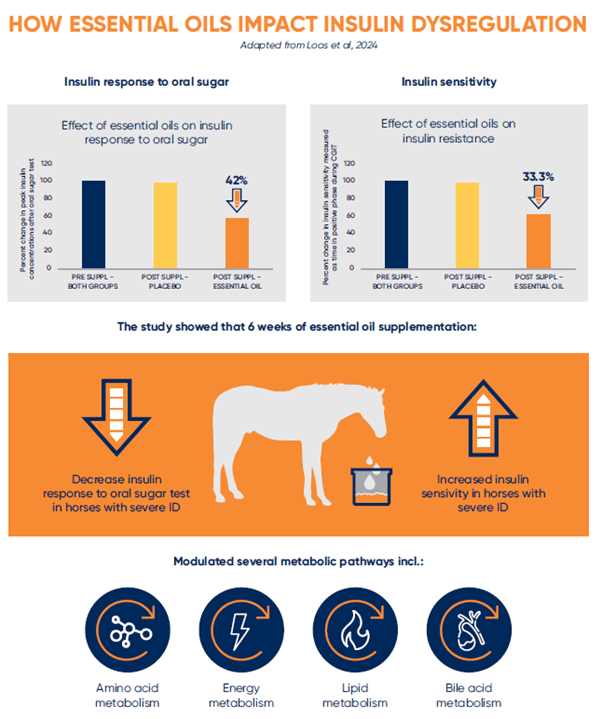
Here, recent scientific research opens a promising new avenue. A placebo-controlled study in horses demonstrated that a specific blend of essential oils — administered orally for 6 weeks — improved insulin sensitivity in horses with severe ID. This was achieved without any changes to diet or management.
Furthermore, specific blood metabolites shifted in a favourable direction: markers related to energy and amino acid metabolism, primary bile acid pathways, and inflammatory processes all improved significantly. This suggests that essential oils can positively influence metabolic dynamics at a cellular level.
This represents a new, exciting approach: not treating symptoms, but addressing the underlying root cause.
What are the first signs of laminitis in horses?
The earliest signs are often subtle: a short, stilted gait, reluctance to turn, increased heat in the hooves, or a horse shifting weight off its front feet onto its hindquarters. A horse that is unusually reluctant to move always deserves closer attention.
Can a horse fully recover from laminitis?
Mild cases can recover well with the right treatment and management adjustments. In severe or recurrent laminitis — especially where pedal bone rotation has occurred — the prognosis is more guarded and lifelong management is typically required.
Is laminitis the same as pedal bone rotation?
No. Laminitis is the inflammation of the laminae inside the hoof. Pedal bone rotation is a possible consequence of severe or untreated laminitis, where the bone loses its normal position.
Which horse breeds are most prone to laminitis?
Ponies (Welsh, Shetland, Connemara), draft breeds, and certain warmblood breeds carry a higher risk due to their genetic sensitivity to insulin dysregulation. However, horses of any breed can develop laminitis, particularly when overweight or suffering from underlying conditions such as PPID.
Can a horse with laminitis still go out on pasture?
During an active laminitis episode: absolutely not. For at-risk horses or those with diagnosed ID: severely restrict or entirely avoid pasture access, especially in spring and autumn. Use a dry lot or grazing muzzle as alternatives.
Can supplements help prevent laminitis?
Supplements are not a substitute for good management, but they can play a supportive role. Recent research shows that specific essential oil blends can improve insulin sensitivity in horses with ID. Always discuss supplement use with your vet, especially in combination with medication.
1. Pollard et al. (2018). Incidence and clinical signs of owner-reported equine laminitis in a cohort of horses and ponies in Great Britain. Equine Veterinary Journal.
2. Loos et al. (2024). Essential oil supplementation improves insulin sensitivity and modulates plasma metabolome of hyperinsulinemic horses. Frontiers in Veterinary Science, 11, Article 1444581.